My Five-Month Rehab Log for Iliotibial Band Syndrome (ITBS)
- No.
- 178
- Date
- Read
- 5 min
- Words
- 1,135
The story starts on New Year's Day this year, when Jiahua and I went hiking on Mount Emei.
While I was still on the mountain, the pain in my IT band was already unbearable. Sure enough, after I came down, I was formally diagnosed with an old friend of sports lovers: iliotibial band syndrome (ITBS).
Five and a half months have passed since that descent. I only truly started taking it seriously and working on it in February this year. Over these months I went from confusion and pain to gradual recovery. Today I want to share this hands-on experience with anyone troubled by pain on the outside of the knee.
01 The Hidden Killer: What Is Iliotibial Band Syndrome?
Simply put, when you walk, climb stairs, or do any exercise that bends your knee, if you feel tightness or even pain on the outside of one (or both) knees, this is most likely it.
The pain is sneaky. At first, it just makes you a little uncomfortable. If you ignore it and keep bending and straightening your knee, the discomfort turns into unbearable sharp pain, and at its worst you can hardly walk.
What's more frustrating is how deceptive it is. After one night of rest, the outside of your knee goes back to normal, no pain at all. That makes you think, "I'm better." But as soon as you exercise for a long time again, the pain comes right back.
I love cycling. On January 31, after getting hurt, I rode the Chengdu Tianfu Greenway for the first time. At first everything was fine, and I could even push hard with my friends. But as the distance approached 50 km, my knee started to ache. I forced out a few more kilometers, then the pain fully erupted, and in the end even walking my bike was extremely hard.
That painful lesson is what made me really start studying it and try to rehab it with my own training.
02 Finding the Culprit: Why Does This Happen?
Know the enemy and know yourself, and you can treat the right problem.
The iliotibial band is a strip of fascia- or ligament-like tissue along the outside of the thigh. One end attaches near the knee, and the other connects to the tensor fasciae latae (TFL) and gluteus medius higher up the thigh.
At its core, ITBS is the IT band being pulled too tight. When the knee bends and straightens over and over, the tight IT band keeps rubbing against the outside of the knee, and over time that causes pain.
So why is it tight? Blame the two "managers" above.
In most cases, the cause is the glute medius going on strike. When the glute medius is weak and not doing its job, the TFL is forced to pick up the slack and work overtime (overuse).
That creates a vicious circle:
- The TFL tightens from overuse.
- Its tightness pulls on the IT band below.
- The IT band is passively stretched, and ends up extremely tight.
Once you understand this, the treatment approach is very clear:
👉 Strengthen the glute medius (send the striking worker back to work)
👉 Release the TFL (let the overworked employee rest, so it stops tugging on the IT band)
👉 Stretch the IT band (ease local tightness)
03 Simple Is Best: My Minimalist Rehab Routine
From February to now, three and a half months, I've been doing rehab training. The core goal is only one: wake up and strengthen the glute medius, and take the load off the TFL.
After lots of trial and error (I tried clamshells and crab walks, but personally couldn't find where to feel the work), I finally cut my training down to two exercises, and so far they work very well:
Exercise 1: Seated hip abduction (at the gym) I always do this on the machine at the gym. I can feel the glute medius firing precisely and strongly.
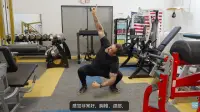
Exercise 2: Side-lying leg raise (at home) Lie on your side on a yoga mat and raise your leg. You can do this anywhere, anytime, and it's extremely useful.
My consistency: Honestly, I slacked off a lot during these three and a half months. I only trained the glute medius specifically for about a month and a half at most. But I stretched my IT band at home pretty much every day.
Even with that on-and-off rhythm, I've recovered to where I am now. If I could train with discipline every day, I believe recovery would be twice as fast.
04 Results and a Guide to Pitfalls
Here's where I am now (using cycling as the example):
- January 31 (flare-up): About 50 km on the greenway, pain too much to bear.
- Early rehab: Once my ride reached about 40 km, I felt clear discomfort.
- Now (today): 65 km in total, including a hard stretch at a steady 35 km/h. I felt good the whole way, with no discomfort on the outside of my knee at all!
Of course, I took some wrong turns in these five months, so here are some pitfalls to avoid:
❌ Glucosamine rub: Tried it, personally didn't find it useful.
❌ Medicated plasters: I bought a so-called "IT band traditional Chinese medicine plaster." It burns when you put it on and gives you the illusion that you're being treated, but it actually does nothing.
✅ MRI: I went to the hospital for a scan to rule out other structural problems like a meniscus tear, for peace of mind (the result showed no problems at all).
05 How to Tell If You've Got It
I think ITBS is a sports injury that's relatively easy to self-diagnose. If you suspect you have it, compare yourself against these two points:
- Triggered by specific conditions: Normal walking and daily life feel fine. Only after a long period of knee bending and straightening (like long runs or long rides) do you get clear pain on the outside of the knee.
- Stretching relieves it right away: When the pain flares up, stop immediately and stretch your IT band, and the pain eases very noticeably, almost instantly.
If both fit, you can basically make a preliminary call of ITBS. (Of course, if the pain is severe or comes with other symptoms, be sure to see a doctor.)
Final words:
In these past five months, I haven't had a single truly satisfying ride. That's nearly half of this year, and for someone who loves exercise, it's been a long, agonizing torment.
It may still take two or three months to recover 100%, but seeing a pain-free 65 km ride today, I know I'm heading in the right direction.
I hope this little bit of shared experience helps the runners and riders who are going through this.
Train smart, and recover patiently!