A Low-Strain Workout Combo
- No.
- 276
- Date
- Read
- 9 min
- Words
- 1,856
It's nearly the end of the year, and my dad's work has slowed down, so he's been home a lot more lately. I remembered that my mom kept bringing up Guangwu Mountain a while back. She said she wanted to go see the autumn leaves there. Right now is the perfect time for that, and my dad happened to be free, so I wanted to send my parents off on a trip.
But after looking into it, I found that the drive from Chengdu to Guangwu Mountain takes at least six or seven hours. That's way too exhausting. My mom doesn't have the stamina, and she really couldn't handle all that travel.
So I found a stand-in: Mount Wawu. It's in Hongya County, in Meishan. Jiahua and I visited it over Chinese New Year last year, and it really is a wonderful place. It isn't far. You can get to the area in about three hours by car from Chengdu, and there are other sights nearby, like Liujiang Ancient Town and Yanü Lake, that you can see along the way. Two days is enough for an easy, relaxing trip.
My parents left today. By the time I'm writing this, I'd guess they've already seen the Reclining Buddha at Caoyutan and are strolling around Liujiang Ancient Town.
With my parents away, I had the house to myself. It was a little chilly and I had nothing to do, and days like that always drag. In the morning I came up with a bunch of Vibe Coding1 projects and had Claude build demos for them. But I usually lost interest halfway through.
So I lay in bed and watched a short drama, a lazy bit of "Hongguo time."2 At noon I went downstairs for an 18-yuan rice bowl. Back home, I opened the Maoyan app and remembered that Swordsman II, which I'd been keeping an eye on, was back in theaters. So I booked a ticket. I'd wanted to see it in a Dolby Cinema, but it was too far away, so I settled for the giant-screen theater near my place and went by myself.
After that I watched two episodes of Tales of Herding Gods at home, and it was already one o'clock. I checked the time, didn't put it off any longer, changed my clothes and headed to the gym.
Okay, I think I'm finally getting close to the point. I came up with this post while I was working out at the gym. I had the title and the rough content pretty much figured out from the start: I want to share what I do for my low-intensity workouts. A lot of people can do these at home. You won't feel wiped out afterward, but you'll still feel like you actually worked.
And all that stuff up top is really just my way of saying this: Exercise doesn't have to push you to your limit. It can also add a little extra comfort to a lazy day.
Lately my traps and my neck and shoulders have been pretty stiff, and it's been giving me cervicogenic headaches.3 In the morning I gave my traps a good going-over with a massage gun, which hurt in the best way. But when I got to the gym in the afternoon, I could still clearly feel that my rear delts, and my whole neck and shoulder area, were worn out.
Given how my body felt today, I decided that even though it was supposed to be back day, I'd do some low-intensity work to help my body feel better.
The workout is really simple. I'll go through it one move at a time.
The Workout
Lower Body
90/90 Hip Switches
Youtube@The Active Life
The 90/90 hip switch4 is a really common hip mobility exercise. A lot of programs put it first. It's very basic: just sit down on the floor anywhere and do it. It's also very effective, because it works your hips' internal and external rotation at the same time. If your hip mobility is limited, you'll really feel it working.
One rep is one switch to each side. Do 3 sets of 12.
Single-Leg Hip Rotations with a Foam Roller Against the Wall
Youtube@Dr. Claire Bowes
In terms of order, the 90/90 hip switch can be thought of as the lead-in or warm-up for this one.
Here's how it goes: stand on one leg, press a foam roller against the wall with the other leg, then open and close by rotating at the hip. The whole time, your standing leg keeps your pelvis steady and resists the wobble from the rotation.
To me, this move is "top of the top tier."5
Here's roughly what it does:
- It builds strength and endurance in your glute medius and the deep external rotators at the back of the hip;
- It improves hip stability when you're on one leg, so your knees are less likely to cave in when you walk, run or squat;
- It improves active control and range of motion in hip internal and external rotation.
My physical therapist taught me this one. Once I tried it, I found it's really effective and super easy to get started with. This one move alone works the stability of your whole lower body. I love it.
One thing to watch: Turn your body from your hips. Don't let your lower back take over.
Do 12 reps per set, alternating legs, for 3 sets on each side.
Core: Planks
Youtube@Balance In Motion
After those two moves, grab a yoga mat and do some planks.
I don't need to say much about why planks are good for you. Like push-ups, they're practically a national pastime. Just find a spot, get down and go.
My first set is 1 minute, and the next two go to failure. 3 sets in total.
Here's another interesting idea I came across:
The gist is this: The mild pain and frustration of exercise make your brain stronger. They help you be tougher and stick with things when life gets hard.
The article explains this "switched on" feeling that comes with the discomfort: physical challenges boost the release of brain-derived neurotrophic factor (BDNF),6 which it calls "fertilizer for the brain."
So when you're close to failure in a plank, every extra second you hold on may be changing more than your core strength. You're also quietly rebuilding your brain.
Upper Body
Strict Press
Youtube@The Pump Club
Just like the single-leg hip rotation with a foam roller, the strict press7 is a top-tier move in my book. What they have in common is this: One move trains a lot more.
The strict press works your front delts, side delts and triceps all at once. It also really tests your core stability.
Don't go heavy without thinking. As a rule, the weight should be only 40% to 60% of your working weight on the bench press. Pay special attention to bracing your core and locking in your lower body. Don't let your core wobble, or you could hurt your back.
Do 3 sets of 5 to 10 reps.
Dead Hangs
Youtube@Adam McCubbin
I won't go on about the benefits of dead hangs here. For the details, you can read the post I wrote earlier about grip strength and dead hangs.
In short, hanging doesn't just build grip strength. It also relieves the shoulder tension that comes from sitting all day. A lot of the time, hanging doesn't tire me out at all. My upper body actually feels a lot looser afterward.
One set is 50% of your max hang time. 3 sets is plenty. Retest your max every so often.
Farmer's Walk
Youtube@CrossFit
Just carrying two dumbbells around can work you hard. From the name and the move itself, it's easy to see that a lot of the time, exercise is really about making everyday life easier.
People today live in cities. We don't lift and haul heavy things all the time like farmers in the countryside do. So these everyday movements have become exercises in the gym.
The method is simple too. Pick a weight that feels manageable, hold one in each hand, and walk laps around the gym until you can't hold on anymore.
Generally, a good weight is one you can carry for about 40 seconds.
As for how many laps, that's up to you.
Flexibility
Lately my flexibility work has been entirely the four moves Huberman8 recommends, and they've been great.
All four are really simple and easy to get started with, but the results are very noticeable. You can do them at home. I'd suggest everyone do them whenever you have a moment.
I wrote about Huberman's training plan in another post, if you're curious.
The four moves are:
- Sumo squat
- Bring your knees behind your hips
- Reverse tabletop
- Founder's pose9
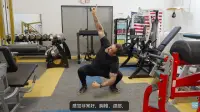
Sumo squat Youtube@Andrew Huberman
Bring your knees behind your hips Youtube@Andrew Huberman
Reverse tabletop Youtube@Andrew Huberman
Founder's pose Youtube@Andrew Huberman
I don't think these four need any explaining. Anyone can tell how to do them just from the four screenshots above.
So if you're interested, why not put down your phone and give them a try right now!
That's everything I did in today's workout. The whole thing took about an hour, and the intensity wasn't high at all. Afterward I wasn't tired. If anything, my body felt lighter and I had more energy.
When I got home, I wrote this post in under 50 minutes, all in one go. I wonder if some of that was the boost exercise gives the brain.
Either way, it's a really nice feeling.
Well, that's it for now.
Footnotes
-
Vibe Coding: a way of programming where you mostly describe what you want to an AI in plain language and let it generate the code. The developer focuses on the "feel" and the result rather than writing code line by line. ↩
-
Hongguo: short for Hongguo Short Drama, a free short-drama app in China. ↩
-
Cervicogenic headache: a headache caused by problems in the cervical spine and the muscles and soft tissue around it. It often shows up as pain at the back of the head or the temples, along with stiffness in the neck and shoulders. ↩
-
90/90: the position of the legs while seated, with the hips and knees of both the front and back leg at roughly 90°. The hip switch means alternating this position from one side to the other. ↩
-
"Top of the top tier": the Chinese is hang (夯), internet slang from hang bao le. In tier-list memes like "hang / top-tier / elite / NPC / trash," it's the highest rank, meaning "absolutely amazing." ↩
-
BDNF (Brain-Derived Neurotrophic Factor): a protein that supports the growth, survival and synaptic plasticity of neurons. Research shows exercise can raise its levels. ↩
-
Strict press: the standing barbell press (Strict Press / Overhead Press). You don't use your legs at all and press the bar from your shoulders to overhead using only your upper body. ↩
-
Huberman: Andrew Huberman, a professor of neurobiology at Stanford University and host of the podcast Huberman Lab. He often shares science-based advice on exercise, sleep and more. ↩
-
Founder's pose: a core move from Foundation Training, created by Eric Goodman. You shift your hips back and lean your torso forward to strengthen the posterior chain and improve posture. ↩