Iliotibial Band Syndrome? What to Do About It
- No.
- 061
- Date
- Read
- 3 min
- Words
- 555
At the start of this month, on Mount Emei, I felt the pain of iliotibial band syndrome for the first time.
What does it feel like? There's a spot on the outer side of my knee, and whenever my thigh muscles tense, bending the knee causes sharp pain.
After I came down from Mount Emei, I rested for two days, the pain in my left knee all but vanished, and I figured I was fine.
A month is almost gone. Today I headed out on my bike for my first loop of the Tianfu Greenway in 2026. The first half went smoothly, but after fifty kilometers, my left knee started hurting again, just like that night on Mount Emei.
I knew it was bad. Once I realized something was wrong, I told my riding partner right away: "I can't keep riding."
That's no exaggeration. If I'd gritted my teeth and finished the second half, I'd have been in agony when I got home.
This condition is called iliotibial band syndrome. After reading up on it online, I found that it's a very common overuse injury among runners and cyclists.
So how should we deal with it?
I'd break it into three steps: first, relieve the pain in the acute phase; second, release and stretch; and third, build muscle strength, which treats the root cause.
When you clearly notice pain on the outer side of your knee during exercise, stop exercising right away. If you grit your teeth and push on at that point, you'll significantly extend your recovery time.
Then ice it. Ice can effectively relieve the pain (don't press ice cubes straight onto the sore spot. Wrap them in a towel or use a medical ice pack).
Step two is stretching. Once the acute pain eases, you can stretch the IT band.
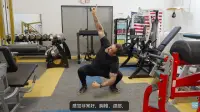
You can use a foam roller on the IT band, glutes and the outer quads. You can also do standing IT band stretches aimed at it.
Step three is strengthening.
IT band syndrome isn't incurable. It happens at root because the glute muscles are weak, especially the gluteus medius. When the glutes can't stabilize the pelvis, the IT band has to overcompensate to keep things stable, which leads to tightness and friction.
So targeted training for the glutes, especially the glute medius, is very important.
Common exercises include clamshells, side-lying leg raises, single-leg deadlifts and glute bridges. Of these, clamshells and side-lying leg raises can both be done at home as bodyweight exercises with no equipment.
I'd suggest that anyone with IT band syndrome like me train their glutes every day, to fully fix the problems around the IT band.
I can't help sighing about it. IT band syndrome is like a hurdle that only people who exercise run into. It tells us that maybe your aerobic fitness is already strong, maybe you can bench 100 kg, but your glutes are too weak.
A person's physical fitness is like a wooden barrel. How much it can hold is decided by the shortest stave.
So training is something that needs balance, like yin and yang. Beyond the most basic measures of weight and volume, the body has many other indicators worth caring about.
On top of everything else, we also need to remember: avoid getting hurt while exercising as much as you can.