Why Hasn't My IT Band Syndrome Healed Yet?
- No.
- 232
- Date
- Read
- 4 min
- Words
- 838
I've thought this through carefully, and the conclusion I keep coming back to is: I've been too lazy.
I once asked two riding buddies about it. Both had suffered through knee pain. The first got his from running. He said he stopped training for six months and it healed on its own. The other is Master Peng, who runs an online cycling-apparel shop. I got to know him because I was shopping for cycling kit (though I haven't actually bought any yet). Once, when we went out riding together, he asked me how my IT band was doing.
He must have seen my old WeChat Moments posts and known about my knee. So we got talking, and I found out he'd had IT band syndrome too.
So I asked him more: how long did it take to heal? How did you get better?
He also said it took six months. But unlike my other friend, who stopped training completely, he found a rehab therapist, stuck with his rehab, and released his legs every day with a foam roller.
Since I got hurt on January 1, my IT band syndrome has now lasted eight months and ten days. I'm much better than at the start. Aerobic rides of a few dozen kilometers a day are no problem at all. But as soon as I have to put in hard efforts or ride at intensity, I still can't keep up.
Over the past six months I've tried lots of things, but at root they all come down to the same idea. After I had an MRI on my bad leg and confirmed there was no meniscus damage, I officially started treating it as IT band syndrome.
IT band syndrome is, at its core, a tight iliotibial band caused by a weak gluteus medius, with the tensor fasciae latae (TFL) taking over and overcompensating for it.
The principle of treating it is to release the tight TFL and get the glute medius, which has stopped doing its job, back to work.
So my main approach over these six months has been to train my glute medius and release my TFL.
The approach is clear. My follow-through, though, has been truly terrible. Especially on releasing the TFL. I train my glute medius more or less every time I go to the gym, since it's just hip abductions and the like, which are easy to do.
But releasing the TFL? As far as I can remember, I've hardly ever done it.
Why?
First, sometimes I'm not sure if what I'm pressing is even the TFL. It's a muscle in an awkward spot. On an anatomy chart, it sits roughly where the front pocket of my jeans would be.
But after a few stretching sessions, I never could feel it. No positive feedback, and that's a big reason I mostly stopped stretching later.
Second, it hurts too much. Honestly, it's not just the TFL I've slacked on. I never paid much attention to stretching in the past. It was only this year, after IT band syndrome and a long stretch of being hurt, that I started learning a lot about stretching and releasing.
I'll go so far as to say this: just as leg day is the hardest part of working out, lower-body release and stretching is the most painful part of the whole body.
Lately, because I just can't hold back the urge to get out on the bike anymore, I've gone back and learned a lot more about lower-body release, and started doing it myself.
I decided to stop agonizing over exactly where the TFL is and just give my whole lower body a thorough release.
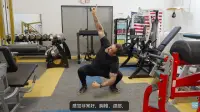
Along the way, I learned a method called "dynamic fascial release." In short, after a systematic foam-rolling session on your lower body, you find the spots on the inside and outside of your thigh that feel really painful, keep pressure on that spot, and bend and straighten your knee through 90°.
This feels amazing, far better than just lying with your leg on the foam roller.
The funny thing is, everything in my lower body feels tight. So for the past few days, I've had to find several spots on each leg for dynamic fascial release.
After sticking with it for a few days, I think I've found my TFL. It's close to where the anatomy chart puts it, and more importantly, that spot is incredibly tight every time I press on it.
Tomorrow I have an appointment with a rehab therapist, to get a professional release and find out exactly where things stand.
Thinking back on these eight months of rehab, the whole thing could be summed up in one word: lazy.
I never went to see a rehab therapist. I learned plenty of theory, but I badly lacked action.
Only when reality backed me into a corner did I look for a way out.
This time I really can't be lazy anymore. I just want to go on one good, proper ride so badly.