My Thoughts on A Touch of Zen
- No.
- 248
- Date
- Read
- 4 min
- Words
- 800
A round trip between Chengdu and Shenzhen by plane takes about four hours if the flights go smoothly.
If it were you, what would you do with those four hours?
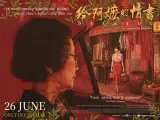
I made the trip last week, and I spent the four hours watching one movie: A Touch of Zen.
A reader recommended it in the comments of my Kill Bill post. I made a note of it, so I watched it.
Honestly, very few movies in my watch list are this old.
It came out in 1970, which means that when it was released, my father wouldn't be born for another nine years.
But even though it's so old, the experience it gave me was like nothing else.
When that reader recommended it, they told me it was a wuxia film. And because of the title, I naturally believed it.
When it comes to wuxia films, I don't have many in my head. The ones I can name are Zhang Yimou's Hero and Ang Lee's Crouching Tiger, Hidden Dragon.
Both are great, and for strikingly similar reasons.
Beyond the wuxia genre itself, their camerawork and imagery are stunning, and that beauty is built on a strong Chinese aesthetic and deep atmosphere.
There haven't been many wuxia films in China in recent years. The ones I can name are Xia Zhi Da Zhe and Blades of the Guardians.
Compared with films from decades ago, these two have made technical progress in the picture, but in terms of aesthetics and atmosphere, they're far behind.
So what does all this have to do with A Touch of Zen? The connection is that I think A Touch of Zen is an extreme film, one where director King Hu1 poured his expressive intent into the atmosphere and the shot design.
As for the plot, the film runs three hours, and the story is actually simple. It's told from the point of view of Gu Shengzhai (the male lead), a painter whose talent has gone unrecognized. He notices that a group of strangers has recently arrived in the small town where he lives. They pose as doctors, blind men, and so on, and seem to have nothing to do with each other, but there's an undercurrent running underneath.
And Gu Shengzhai is the only one who notices it. From there the story brings in the swordswoman and her tragic backstory: her father was an imperial censor in the capital who submitted a memorial impeaching Wei Zhongxian.2 Wei Zhongxian had her entire family executed, and she fled with a few capable followers to the place where Gu Shengzhai lives.
Later the swordswoman discovers Gu Shengzhai is no ordinary man. They fall for each other and end up together. To help her, Gu Shengzhai volunteers to serve as her strategist, which sets off a series of resisting, being hunted, escaping, and resisting again.
As a story, I think this film is simple, even mediocre.
But a movie isn't only about its story. Sometimes a simple story is actually an advantage, because it does no harm and no great favors, and lets the audience see what's more outstanding about the film.
First, pacing.
A Touch of Zen runs two hundred minutes and tells a simple story. That length means the film is bound to unfold at an unhurried pace, and the director uses it to film lots of scenes and the details of the characters' expressions and movements. I was completely absorbed, especially by the setup of "a group of strangers comes to the village, and only I notice something's wrong." Watching Gu Shengzhai slowly uncover the village's oddities gave me a sense of mystery and excitement.
Compared with how almost assembly-line today's movie pacing is, a slow pace like this makes a simple story feel textured.
And King Hu's camerawork is crafted with real ingenuity. The film is full of images where beauty and atmosphere coexist.
Second, shot composition.
I think shots like these may only be found in the films of the past, and I happen to love them.
I find them clean and elegant. They keep the emotional force of the scene and are still very beautiful.
Hard and soft at once.
Hard and soft at once is the point, I think. In recent years, movie shots have cared more and more only about bigger set pieces and stronger visual impact, and when it comes to emotion, a lot of films present it in isolated single frames.
Footnotes
-
King Hu (1932–1997) was one of the leading figures of Chinese-language wuxia cinema. His best-known works include Come Drink with Me, Dragon Inn, and A Touch of Zen. ↩
-
Wei Zhongxian (1568–1627) was a eunuch of the late Ming dynasty who held enormous power during the Tianqi reign and was purged after the Chongzhen Emperor took the throne. ↩