Dorami and the Phantom
- No.
- 069
- Date
- Read
- 3 min
- Words
- 567
Over the past two weeks I've watched two K-dramas: Can This Love Be Translated? and Spirit Fingers.
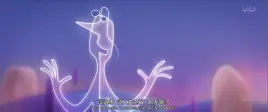
Both are melodramas. But interestingly, both have a being who's born from the protagonist and yet separate from her. In the first it's Dorami, Cha Mu-hee's second personality. In the second it's the Phantom, Song Woo-yeon's imaginary companion.
I can't help linking Dorami and the Phantom. Or rather, I think they mean the same thing. The writers just built them in different ways.
Look at Dorami's Mu-hee and Song Woo-yeon. The first had serious childhood trauma and instinctively backs away in relationships. The second grew up in a repressive family and became insecure, reserved, and always on the margins.
Dorami and the Phantom are both born from their owners' dissatisfaction with real life, and from wanting things they can't have.
With Joo Ho-jin, there are lots of things Cha Mu-hee wants to do but doesn't dare. When she switches into Dorami form, she goes and does them.
Song Woo-yeon, raised under her mother's stifling parenting, became a colorless high school student who could hardly develop a personality of her own. When she sees a pretty outfit, all she can do is picture the Phantom wearing it. When something's bothering her, she talks it over with the Phantom.
Dorami and the Phantom both stand opposite their owners. They're products of a certain kind of life and a certain state of mind.
And both of them, as it happens, disappear at some point in their shows. Dorami "dies" once Cha Mu-hee finds happiness and resolves what was weighing on her, and the Phantom vanishes once Song Woo-yeon dares to stand up to authority and let her colors show.
So at heart, Dorami and the Phantom are both offshoots of a person's real life, and that real life is usually not a happy one. In a word, neither of them dares to look her own feelings and thoughts in the face. Whenever they try to work up the courage, the first things that come to mind are self-doubt and giving up. They're awkward and tangled up inside.
It's exactly because all that self-doubt and giving up became a habit that Dorami and the Phantom came to be.
What's interesting is that Spirit Fingers and Can This Love Be Translated? both came out within the past six months, and this is the first time I've seen these two fairly similar setups in K-dramas.
I don't know if older K-dramas ever used this kind of device, but I think taking the part of a protagonist that's suppressed, or the part she wants to become, and showing it as a separate character is a brilliant idea.
Everyone is an island. How someone looks to the outside world isn't necessarily who they really are inside. It really is like Dorami and the Phantom: in behavior and personality, they're truly two different people.
Acting it out this way doesn't just make the characters' inner conflicts concrete. It also makes the story more fun.
K-drama character writing seems to care a lot about a person's past.
Thinking about it, that's true. People often pick up, in childhood and adolescence, the good traits and the bad ones they'll never shake for the rest of their lives.
The more of this I see, the more I feel that one small thing in growing up really can shape a person's whole life.